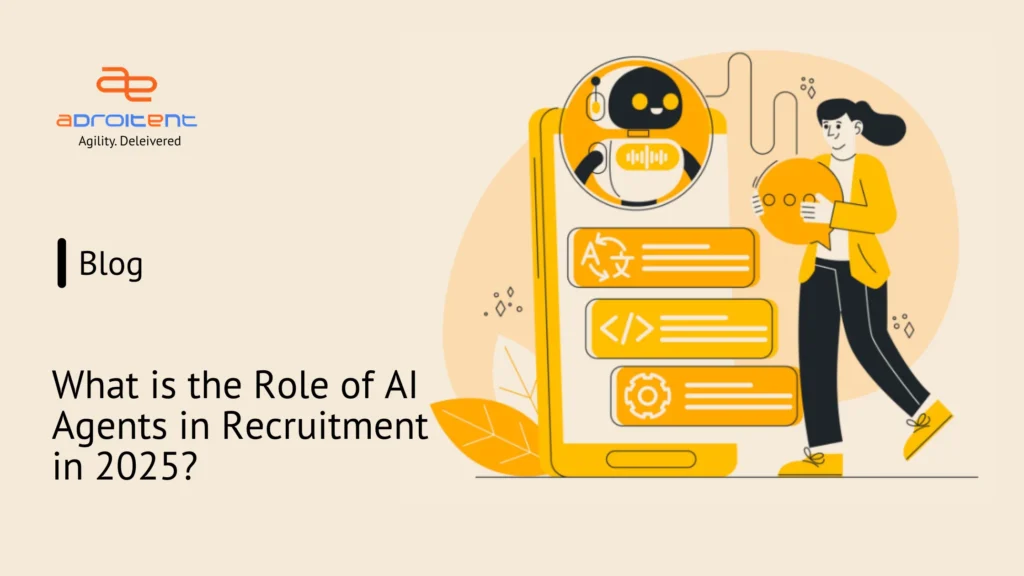
What is the Role of AI Agents in Recruitment in 2025?
The Role of AI Agents in Recruitment in 2025 | Adroitent Home/ Blog/ The role of AI agents in recruitment in 2025 Insights · Artificial Intelligence What is the role of AI agents in recruitment In 2026, AI agents are playing a pivotal role in reshaping recruitment strategies for enterprises and multinationals, making the process faster, data-driven, and candidate-centric. Adroitent InsightsArtificial IntelligenceTalent Acquisition5 min read Key takeaways AI agents move recruitment from time-consuming manual screening to a proactive, strategic, efficient process. They bring cognitive capabilities — understanding context, recognizing patterns, and adapting matching algorithms as they learn. Benefits include faster time-to-hire, higher quality of hire, bias reduction, and predictive workforce planning. Talentalign is Adroitent’s job-description-driven AI agent, built by the AI Center of Excellence (AICoE). IntroductionAI agents are reshaping recruitment In 2025, Artificial Intelligence (AI) agents are playing a pivotal role in reshaping recruitment strategies for enterprises and multinationals, making the process faster, data-driven, and candidate-centric. These AI agents are bound to transform every facet of the recruitment life cycle, moving it from a time-consuming process to a proactive, strategic, and efficient process. The challengesMajor recruitment challenges faced by recruiters in 2025 Traditional recruiters relied more on manual screening, smaller networks, and older versions of Applicant Tracking Systems (ATS). Some of their common challenges include: Sifting resumes: Recruiters struggle manually sifting through thousands of applications for specific skill sets that becomes a time-consuming task. Greater competition: While drawing from global talent pools, recruiters face intense competition from others for the same pool of skilled professionals. Timely hiring: Businesses need faster hiring for project-specific roles by recruiters. Any delay in hiring impacts project delivery, innovation cycles, and ultimately brand value. Candidate experience: Due to delayed feedback from recruiters, the candidates might shift to other sources. Today’s candidates expect faster feedback and seamless experience from first touchpoint to offer acceptance. Thus, traditional Human Resource Information Systems (HRIS) and Applicant Tracking Systems (ATS) alone are no longer sufficient. This is where AI agents step in as the strategic orchestrators of talent. In 2025, enterprises and businesses require scalable, intelligent, and automated AI agents to keep pace with their dynamic global expansion demands. The shiftWhat is the role of AI agents in recruitment? AI agents in recruitment represent a fundamental move from traditional keyword-driven candidate search methods to AI agents that bring cognitive capabilities. These agent capabilities mirror human intelligence while operating at speed, accuracy, and scale. These AI systems understand context, recognize patterns, and make intelligent decisions analyzing complex, and multi-dimensional criteria to shortlist profiles. Unlike rule-based old systems, AI agents adapt their candidate matching algorithms based on real-time outcomes, becoming more accurate and effective as they learn over time to shortlist profiles. This learning capability is particularly valuable for enterprises, multinationals, and GCCs, which often need to fill highly specialized roles with shorter timelines. AI agents are not replacing recruiters; they are empowering them to be more strategic. In practiceThe transformative role of AI agents in recruitment In 2025, AI agents will be deeply embedded across the entire recruitment lifecycle, performing a myriad of intelligent tasks such as: Semantic Job Description Analysis: AI agents go beyond keyword matching, semantically analyze job descriptions, understand the context, experience levels, etc. and shortlist the right candidates with high matching scores. Intelligent Profile Matching: AI agents scan internal and external talent pools (ATS, LinkedIn, GitHub, niche forums, etc.) to identify candidates whose profiles contextually align with job requirements. Automated Scoring & Ranking: AI agents automatically score and rank candidates based on their overall role fit, significantly reducing the manual effort of screening. Automated Summaries & Justifications: AI agents generate natural language summaries explaining why a candidate is a strong fit. Chatbots & Virtual Assistants: Intelligent chatbots handle initial candidate queries 24/7, personalizing communication and guiding candidates through the application process. Interview Scheduling: AI agents automate scheduling across multiple time zones, sending reminders and coordinating with hiring managers, reducing no-shows. AI-driven Assessments: For technical roles, AI agents administer and evaluate coding and technical assessments, providing objective performance data. Behavioral & Cognitive Analysis: AI agents analyze recorded video interviews for communication patterns and cognitive abilities, without human biases. Real-time Market Insights: AI agents monitor talent markets to provide strategic insights for workforce planning and compensation strategies. Predictive Analytics: AI agents predict future talent needs based on project pipelines, technology trends, and attrition patterns. The benefitsWhat are the benefits of AI-driven recruitment for enterprises? The implementation of AI agents in recruitment represents a paradigm shift from reactive to proactive talent acquisition powered with cognitive thinking capabilities. AI agents excel at what traditional recruitment tools struggle with — understanding the nuanced requirements of complex technical roles and identifying the right candidates for the right job role. Some of the benefits include: Accelerates time-to-hire Scalability and higher quality of hire Enhances recruiter productivity with more focus on candidate experience Bias reduction Real-time market intelligence and market insights Predictive analytics for strategic workforce planning Cost efficiency CaveatsData privacy and compliance aspects to ponder While AI agents bring immense value, enterprises need to evaluate the below aspects: Data privacy & compliance: Proper understanding and complying with GDPR, local data laws, and other policies should be taken into account. Bias in algorithms: Continuous monitoring is required to prevent hidden biases in AI models. Change management: Recruiters need training to work alongside AI agents effectively. Candidate perception: Striking the right balance between automation and human touch is the need of the hour for businesses in 2025. ConclusionThe future outlook The role of AI agents in recruitment for enterprises and businesses in 2025 is transformative. They are not just tools but strategic enablers that allow businesses to scale, innovate, and attract world-class talent in highly competitive global markets. By combining the efficiency of AI with the empathy of human recruiters, enterprises can create a future-ready ecosystem that empowers both growth and innovation. These agents are not replacing recruiters; they are empowering recruiters to be more strategic, efficient, and ultimately, more successful in securing the talent
What is the Role of AI Agents in Recruitment in 2025? Read More »