


Insights · Artificial Intelligence
Beyond copilot: what “AI-native” actually means for enterprise CTOs
From autocomplete to outcomes. Every enterprise has deployed an AI copilot — but real transformation comes only when AI is embedded across the full software lifecycle, not bolted onto the IDE.
Key takeaways
- Most enterprise “AI for engineering” stops at autocomplete, delivering only a 10–15% individual productivity bump — far short of the promised transformation.
- The gap between expectation and outcome isn’t a failure of AI; it’s a failure of scope.
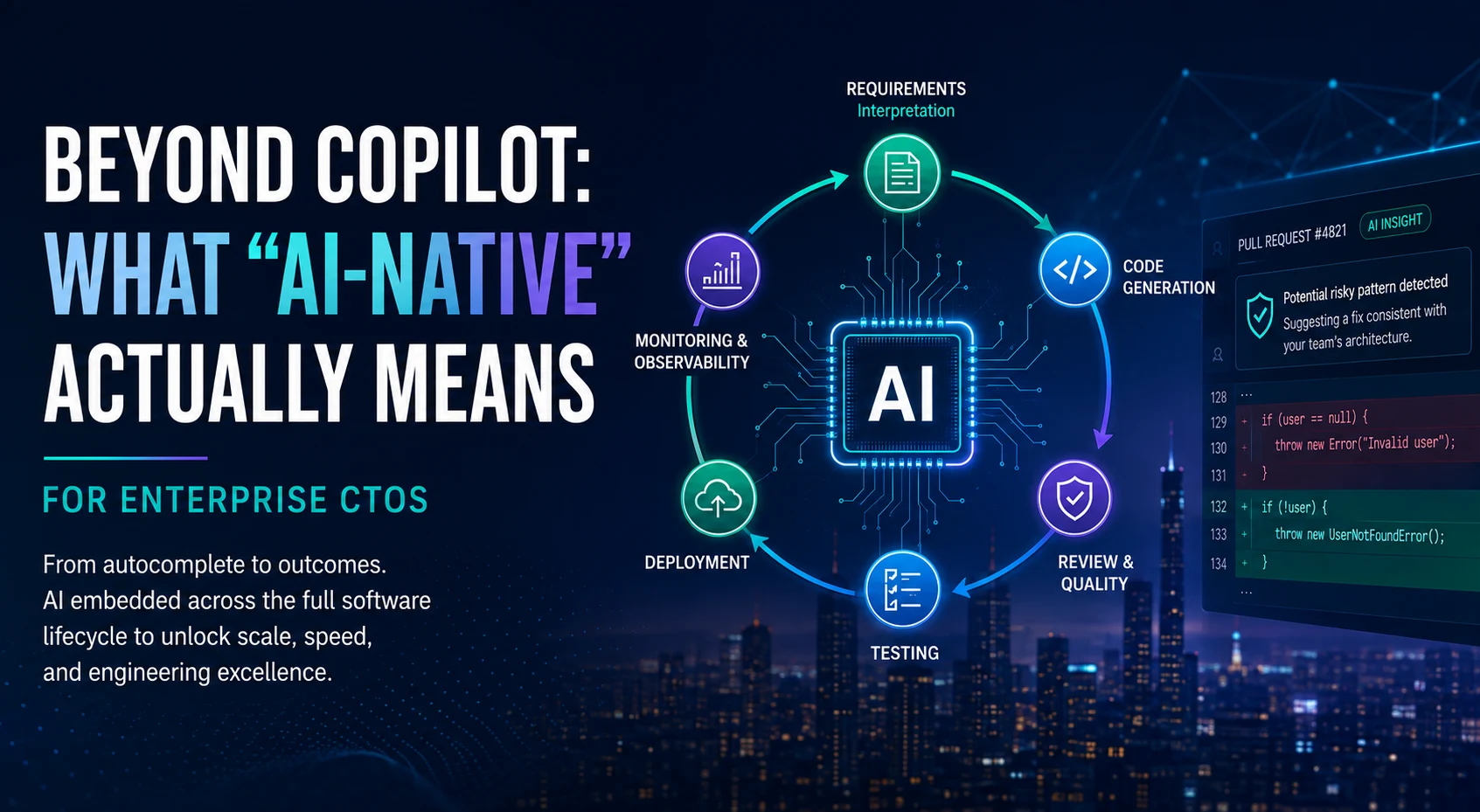
- AI-native means AI embedded across the full software lifecycle — requirements, code generation, review, testing, deployment, and monitoring — not a smarter autocomplete.
- At enterprise scale, AI that holds context across the lifecycle is what reduces debt, speeds onboarding, and prevents quality erosion.
Every enterprise engineering leader has already deployed some form of AI coding assistant. Adoption isn’t the question anymore; impact is. And when CTOs are asked what has actually changed since rolling out AI copilots, the answers are surprisingly modest: faster autocomplete, fewer keystrokes, maybe a 10–15% bump in individual productivity. Useful, but far short of the transformation that was promised.
That gap between expectation and outcome isn’t a failure of AI. It’s a failure of scope.
The trapThe autocomplete trap
Most “AI for engineering” tools today operate at a single point in the software lifecycle: the moment a developer is typing code. That’s a legitimate use case, but it treats AI as a productivity add-on rather than a structural change to how software gets built. The pattern is familiar by now: AI helps write the function faster, but code review still takes just as long. Integration testing, code-complete criteria, and production readiness are untouched. If AI only touches the moment of writing code, it optimizes a fraction of the software delivery lifecycle — and arguably not the fraction that was ever the biggest bottleneck.
The definitionWhat “AI-native” should actually mean
An AI-native engineering platform isn’t a smarter autocomplete. It is AI embedded across the full software lifecycle; from requirements interpretation and code generation, through review and testing, to deployment and post-release monitoring. It doesn’t wait to be invoked. It operates as a persistent collaborator, woven into the way the team already works.
The distinction matters more than it sounds. A copilot waits to be asked. An AI-native platform proactively flags a risky pattern during code review, suggests a fix consistent with your team’s existing architecture, and learns your codebase’s conventions well enough. Its suggestions significantly reduce review time rather than adding another layer for a human to double-check. That’s the difference between a tool that assists one developer and a system that lifts an entire team’s throughput and quality bar at once.
A copilot waits to be asked. An AI-native platform doesn’t wait to be invoked.
Let us consider two teams shipping the same feature. On Team A, a developer gets AI-assisted code in minutes — then waits two days for a reviewer to catch a pattern that violates a convention the AI never knew existed. On Team B, the same risky pattern gets flagged before the pull request is even opened, with a fix suggested in the team’s own idiom. Both teams used AI. Only one of them changed how software gets built.
The scaleWhy this matters more at enterprise scale
For a five-person startup, copilot-level AI might be enough as the codebase is small, the team is co-located, and context lives in people’s heads. Enterprise engineering doesn’t have that luxury. Codebases span thousands of services, teams are distributed across geographies, institutional knowledge decays as people move on, and the cost of a single bad merge compounds across every downstream system. At that scale, AI that only accelerates typing is solving the smallest problem in the room.
What actually moves the needle is AI that holds context across the lifecycle: institutional knowledge about why a pattern exists, the ability to catch inconsistency before it ships, and a real reduction in the manual overhead that scales with team size rather than shrinks with it. Closing that gap is exactly the problem platforms like Devailey are built to solve, treating AI not as a plugin bolted onto the IDE, but as infrastructure woven into how engineering organizations operate, from first commit through production support.
The questionThe real question for CTOs
The question worth asking in your next planning cycle isn’t “which copilot should we standardize on.” It’s this: where in our software lifecycle is AI structurally embedded, and where is it just assisting individual keystrokes?
Enterprises that get this distinction right in the next 15 months won’t just ship code faster. They will build engineering organizations that carry less debt, onboard new hires faster, and scale without the quality erosion that has quietly plagued every large codebase long before AI arrived.
Thus, moving beyond copilots is about shifting from AI-assisted productivity to AI-driven operations and outcomes for unlocking scale, speed, and smarter decision-making across the organization.
Good to knowFrequently asked questions
What does “AI-native” mean in software engineering?
How is an AI-native platform different from a copilot?
Why isn’t a coding copilot enough for enterprises?
What productivity gains do AI copilots actually deliver?
What is Devailey?
What question should CTOs ask about AI in engineering?
Explore Devailey, Adroitent’s AI-native engineering platform, and our enterprise AI solutions.
Move beyond copilots to AI-native engineering.
See how Adroitent’s Devailey embeds AI across your full software lifecycle — from first commit to production.