


Insights · GCC Solutions
GCC-as-a-Service vs. traditional captive models: what Fortune 1000 CFOs need to know
Every budget cycle, Fortune 1000 CFOs face the same question in a new disguise: build or partner? For two decades the default answer for global capability centers was “build.” In 2026, that may no longer be the smart choice.
Key takeaways
- Traditional captive GCCs typically take 12–18 months to deliver meaningful output — a direct cost, not just a delay.
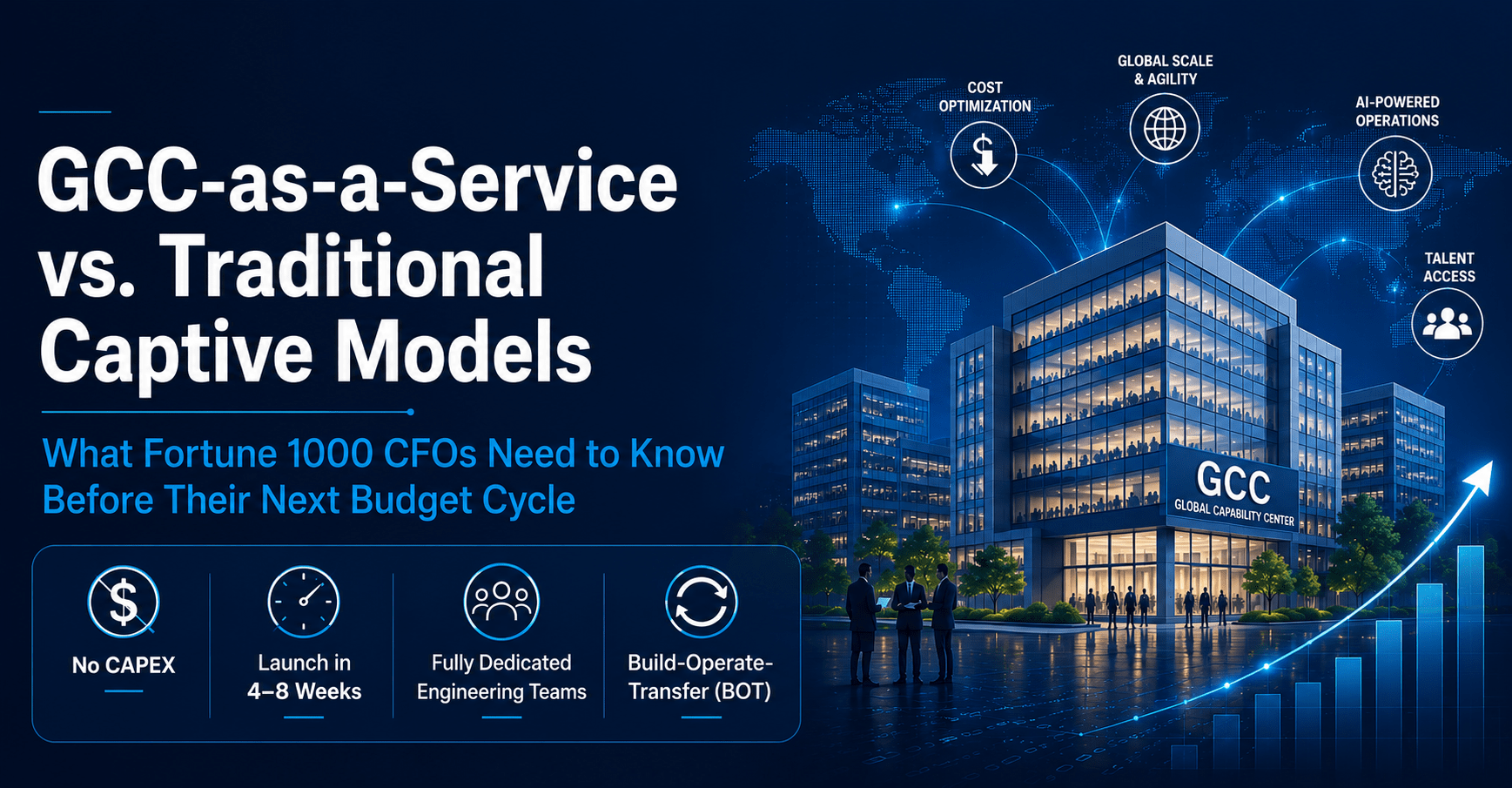
- GCC-as-a-Service shifts spend from CAPEX to a predictable OPEX model and makes teams operational in weeks.
- Build-Operate-Transfer (BOT) preserves the option to convert to a fully owned captive later.
- India’s GCC count has grown from ~1,600 to ~2,120, with an estimated 11–12% CAGR in enterprise value projected FY2025–FY2029.
Every budget cycle, Fortune 1000 CFOs face the same question in a new disguise: build or partner? For two decades, the default answer for global capability centers was “build” — stand up a captive GCC, hire the leadership team, and treat the multi-year ramp-up as the cost of doing business. That playbook is no longer the safest choice. In 2026, it may not even be the smart one.
The hidden taxThe captive model’s hidden tax
Traditional captive GCCs are capital-intensive and slow by design. Entity registration, compliance infrastructure, leadership hiring, and operational maturity typically take 12–18 months for a captive center to deliver meaningful output. For CFOs, that delay isn’t just an operational inconvenience — it’s a direct cost.
There’s also a governance cost that rarely makes it into the initial business case: once built, captive centers are hard to resize. Downsizing carries reputational, legal, and severance costs. Scaling up means re-running the same slow hiring and infrastructure cycle. The model that promised control often delivers rigidity instead.
The model that promised control often delivers rigidity instead.
The shiftWhy GCC-as-a-Service changes the calculus
GCC-as-a-Service inverts this equation. Instead of building infrastructure, compliance, and leadership from scratch, enterprises plug into an already-operational delivery framework designed for flexible engagement. At Adroitent, we structure this around four GCC enablers: AgileSourcing (four engagement models), Talentalign (our agentic recruitment platform), Devailey (our AI platform for software engineering), and a Build-Operate-Transfer model. Together, these give enterprises full control over every function — while letting them choose exactly how much ownership, control, and timeline they want, without paying the multi-year ramp-up tax of a traditional captive.
For a CFO evaluating the next budget cycle, the practical implications are significant:
- Speed-to-value: Teams can be operational in weeks, not quarters — so AI and digital transformation initiatives don’t have to wait on infrastructure.
- Capital efficiency: GCC-as-a-Service shifts spend from CAPEX to a predictable, scalable OPEX model, making for a clearer ROI story in board conversations.
- Optionality: Engagement models like Build-Operate-Transfer (BOT) preserve the option to convert to a fully owned captive later.
- Built for AI-era delivery: Unlike legacy captive models built around IT staffing, GCC-as-a-Service can be structured from day one around AI-native platforms and agentic delivery — not retrofitted for it years later.
Here’s what that looks like in practice: a global manufacturing company expanding into AI engineering needs 300 specialists within six months. Under a traditional captive model, infrastructure and leadership hiring alone could consume more than four months of that timeline. Under GCC-as-a-Service, capability deploys within weeks — ready-to-use infrastructure, niche AI talent, and compliance and legal all managed from day one, while long-term ownership decisions stay flexible.
The numbersThe numbers behind the shift
The momentum behind India as a GCC hub backs this up. Forbes India reports that the number of GCCs in the country has grown from roughly 1,600 to about 2,120 in recent years, driven by both new centers and expansion of existing ones. Technology and software account for 35% of GCC hiring, with BFSI close behind at 21% — together making up more than half of all hiring as of June 2026. PwC projects India’s GCC sector will keep generating enterprise value at an estimated 11–12% CAGR between FY2025 and FY2029, reinforcing that these centers are increasingly engines of business growth, not just cost centers.
The decisionThe decision in front of CFOs this cycle
The real debate isn’t “build vs. outsource.” It’s whether this year’s GCC investment should lock into a fixed, multi-year infrastructure commitment — or stay structured for flexibility while capability and AI maturity are still evolving fast. In a year where enterprise AI strategy is being rewritten quarter to quarter, rigidity is an expensive choice, even when it doesn’t show up that way on a single line item.
The enterprises that win over the next decade will be the ones that build global innovation capabilities faster than their competitors. GCC-as-a-Service offers a practical path there — combining speed, agility, governance, and access to top talent in a single operating model that’s live from day one.
In today’s AI era, competitive advantage belongs to organizations that can innovate continuously. For Fortune 1000 CFOs, GCC-as-a-Service is no longer an alternative delivery model — it’s becoming the fastest route to building future-ready global innovation centers that create sustainable business value. The winners won’t simply build global capability centers; they’ll build them faster, smarter, and with the flexibility to scale as the business evolves.
Good to knowFrequently asked questions
What is GCC-as-a-Service?
How is GCC-as-a-Service different from a traditional captive GCC?
What is the Build-Operate-Transfer (BOT) model?
Why are CFOs reconsidering captive GCCs in 2026?
How large is India's GCC sector?
Explore how Adroitent delivers this through GCC-as-a-Service and Global Capability Center solutions.
Rethinking your GCC strategy this cycle?
Talk to Adroitent about a flexible, AI-native GCC-as-a-Service model — live from day one.