


Thought Leadership · AI Governance
The critical governance checklist for data leaders running AI agents at scale
Enterprises are moving beyond AI pilots to agents that can reason and act. Here are nine governance priorities that let you scale them with confidence.
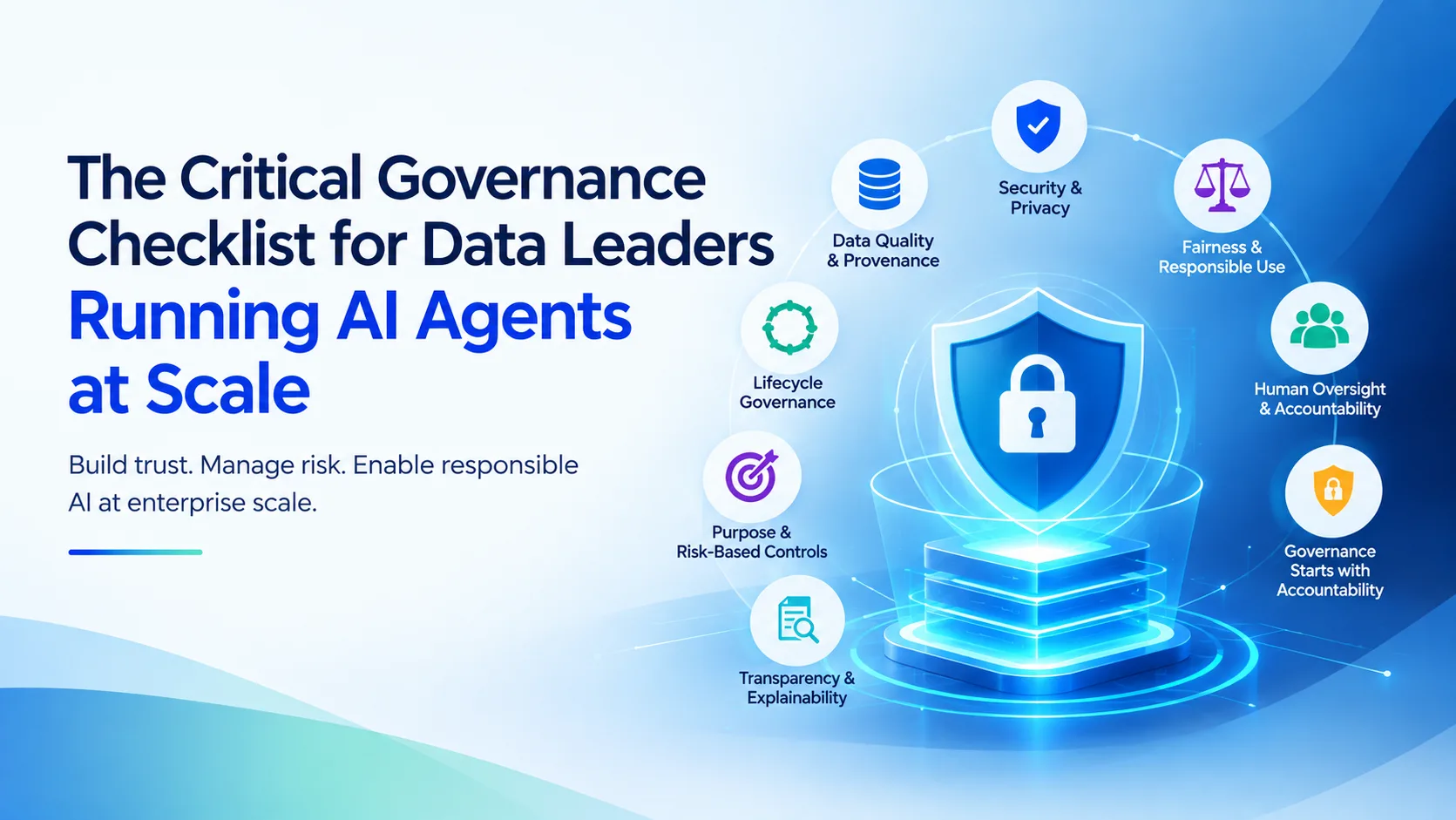
Key takeaways
- AI agents don’t just generate insights, they take action, so governance must cover data access, decisions, and unintended actions.
- Clear ownership, risk-based controls, and a documented purpose for every AI system are the foundation.
- Data quality, transparency, human oversight, fairness, and security must be built in across the full lifecycle.
- AI governance is a business strategy shared by business, IT, security, legal, compliance, and operations.
The shiftFrom AI pilots to agents that act
In 2026, enterprises are moving beyond AI pilots to deploying AI agents that can think, reason, and execute tasks seamlessly. These agents are helping organizations automate workflows, improve customer experiences, accelerate software development, and make faster business decisions.
But as AI agents become more autonomous, they introduce a new level of responsibility. Data leaders are no longer just managing data. They are responsible for ensuring AI agents operate securely, responsibly, and in line with business goals. The real challenge is not simply adopting AI; it is creating the governance framework that allows AI to scale with confidence.
Why it mattersWhy AI agent governance is different
Unlike traditional AI models that generate insights or predictions, AI agents can take action. They can access enterprise data, interact with applications, trigger workflows, and even collaborate with other AI agents to complete complex tasks.
That opens up exciting possibilities, and it raises questions every Chief Data Officer, Chief AI Officer, and data leader must answer:
- How do you ensure AI agents only access the right data?
- How do you monitor their decisions?
- How do you prevent unintended actions?
- How do you stay compliant with evolving regulations?
The checklistNine governance priorities every data leader should focus on
- 1. Governance starts with accountability
- Clearly define who owns AI, who is accountable for each AI system, who approves its use, and who is responsible for managing AI risks throughout the lifecycle.
- 2. Risk-based AI governance
- Not all AI systems need the same controls. Classify systems by intended purpose, potential impact, stakeholders affected, and associated risks, then apply controls proportionate to those risks.
- 3. AI use must have a defined purpose
- Every AI system should have a documented business purpose, intended use, users, boundaries, and expected outcomes. AI should not be deployed simply because the technology is available.
- 4. Govern AI throughout its lifecycle
- Cover ideation and business approval, design, data preparation, development, validation, deployment, operation, monitoring, change, incident management, and retirement.
- 5. Data must be fit for purpose
- Data used by AI should be relevant, accurate, reliable, traceable, and protected, with appropriate controls for privacy and data provenance.
- 6. Transparency and explainability
- Provide appropriate information about how AI is used, its limitations, significant assumptions, and how outputs should be interpreted. Explainability should be proportionate to risk and impact.
- 7. Human accountability and oversight
- AI should support human accountability, not obscure it. Establish oversight, intervention, review, and escalation mechanisms, particularly where AI can significantly affect people or business outcomes.
- 8. Fairness and responsible use
- Identify and manage impacts on fairness, bias, discrimination, safety, privacy, security, accessibility, and other stakeholder concerns, based on the nature and context of the AI system.
- 9. Security, privacy, and resilience by design
- Integrate AI governance with existing information security, privacy, cybersecurity, business continuity, and operational risk practices rather than running it as a separate compliance activity.
Governance is no longer just about managing data assets. It is about enabling autonomous AI to operate responsibly, transparently, and securely.
StrategyAI governance is a business strategy
Successful AI governance is not the responsibility of the data team alone. It requires collaboration between business leaders, IT, security, legal, compliance, and operations. Technology platforms provide the technical foundation, but long-term success depends on clear policies, defined ownership, and a culture of responsible AI adoption across the organization.
How we helpHow Adroitent helps enterprises scale AI responsibly
At Adroitent, we believe successful AI initiatives begin with a strong governance foundation. We help enterprises design modern data platforms, implement AI governance frameworks, and deploy AI and Agentic AI solutions that are secure, scalable, and business-focused.
We are an ISO/IEC 42001:2023 certified organization, and our expertise spans Data Intelligence, AI Engineering, Cloud Modernization, Data Governance, MLOps, and Responsible AI. By combining technology with proven delivery methodologies, we help organizations accelerate AI adoption without compromising security, compliance, or trust.
Final thoughtsGovernance is the foundation for scale
AI agents are rapidly becoming an essential part of enterprise operations, and their impact will only continue to grow. As organizations move from experimentation to large-scale deployment, governance becomes the foundation that determines long-term success.
Organizations that invest in governance today will be better positioned to innovate faster, earn stakeholder trust, and realize the full value of AI in the years ahead.
Good to knowFrequently asked questions
What is AI agent governance?
How are AI agents different from traditional AI models?
Who is responsible for AI governance?
Why take a risk-based approach to AI governance?
Why does human oversight still matter with autonomous agents?
How does Adroitent help enterprises govern AI agents?
See how Adroitent delivers enterprise AI with governance built in.
Scale AI agents with confidence.
Talk to Adroitent about building the governance foundation for responsible, secure, business-focused AI.
Keep reading