


Blog · Data & AI
From legacy to Lakehouse: the new data strategy for modern enterprises
Failed AI initiatives, spiralling infrastructure costs, and data engineers firefighting pipelines instead of building business value all trace back to the same root cause. Here is why the Lakehouse — and Databricks — has become the answer.
Key takeaways
- Legacy data warehouses were built for reporting on structured data — not for the velocity, volume, and variety that define enterprise data today.
- Data teams lose up to 70% of their time to brittle pipelines, data reconciliation, and ageing infrastructure.
- The Databricks Lakehouse unifies storage, governance, processing, and AI through Delta Lake, Unity Catalog, Apache Spark, MLflow, and AutoML.
- Enterprises that migrate report 30–40% infrastructure cost savings and AI moving from proof-of-concept to production in weeks rather than months.
- A phased migration — audit, govern, prioritize, run parallel, decommission — is what separates programmes that land from programmes that stall.
There is a quiet crisis unfolding inside enterprise data teams worldwide, and its consequences show up everywhere: failed AI initiatives, spiralling infrastructure costs, and data engineers firefighting pipelines instead of building business value. The cause is a legacy data architecture that can no longer support the way modern enterprises need to compete. The solution is the Lakehouse — and Databricks is the platform leading that transformation.
As enterprises accelerate their digital transformation journeys, they need a modern data strategy that can unify analytics, data engineering, governance, and AI on a single platform. This is where the Lakehouse architecture, powered by Databricks, is changing the way organizations manage and derive value from their data.
The problemThe challenges of legacy data architectures
Traditional data warehouses were built primarily for reporting and business intelligence workloads. They create real friction when organizations attempt to scale analytics and AI initiatives. Common challenges include:
- Data silos spread across multiple systems
- High infrastructure and licensing costs
- Complex ETL pipelines that increase latency
- Limited support for unstructured and semi-structured data
- Slow access to business insights
- Difficulty scaling AI and ML workloads
As enterprises generate data from cloud applications, IoT devices, customer interactions, and digital platforms, maintaining separate systems for storage, analytics, and AI becomes increasingly inefficient and costly.
The diagnosisWhy legacy data infrastructure fails modern enterprises
Traditional data warehouses delivered reliable reporting on structured, predictable data, but they were never designed for the velocity and volume that defines enterprise data in 2026. Data teams spend up to 70% of their time managing brittle pipelines, reconciling inconsistent data, and maintaining ageing infrastructure. AI and ML initiatives stall because the governed, accessible data they require is perpetually out of reach. Business leaders wait days for insights that should arrive in minutes. The problem is the architecture — and that is precisely what Databricks solves.
By the numbers
of data-team time spent maintaining pipelines and infrastructure instead of creating value
average infrastructure cost reduction after consolidating onto a Lakehouse
not days or weeks — the new cycle time for analytics that previously ran in batch
not months — proof-of-concept to production AI on governed, unified data
The platformWhat makes Databricks the right platform for Lakehouse migration
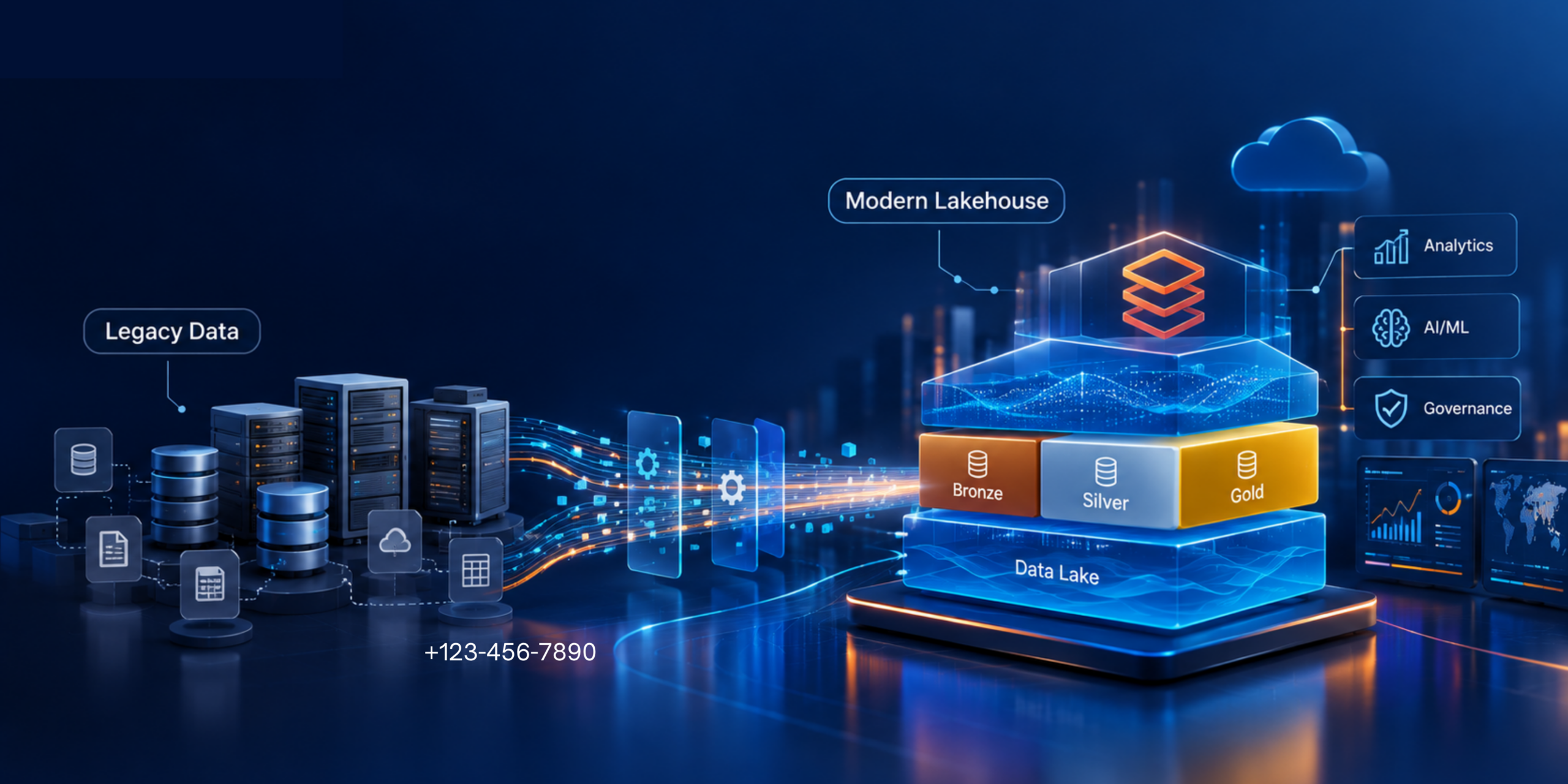
Databricks' Lakehouse architecture addresses those challenges by storing data in open object stores like S3, ADLS, or GCS while adding ACID transactions, metadata management, and indexing for reliable analytics. Built on open-source projects including Apache Spark, Delta Lake, and MLflow, the Lakehouse keeps data free from proprietary formats and closed ecosystems.
Databricks is not just another cloud data platform. It is the most trusted and most adopted enterprise data and AI platform available today.
Databricks introduced the Lakehouse to combine the best capabilities of data lakes and data warehouses into a unified platform. The Databricks Data Intelligence Platform lets organizations store, process, govern, analyze, and apply AI to a single source of truth. Four components do the work:
- Delta Lake
- An open-source storage layer that brings ACID transactions, schema enforcement, and versioned data management to cloud storage. Enterprises get the reliability and query performance of a warehouse combined with the flexibility and cost efficiency of a lake, without compromising either. On one platform, teams run SQL analytics, build and deploy machine learning models, process real-time streaming data, and develop generative AI applications — no duplication, no silos.
- Unity Catalog
- Enterprise-grade governance built directly into the platform, centralizing data discovery, access control, lineage tracking, and compliance enforcement across every workload and cloud. For enterprises operating across multiple geographies and regulatory environments, compliance becomes an automatic, platform-enforced standard.
- Apache Spark
- Processes data at a scale and speed legacy systems cannot approach — accelerating ETL pipelines, reducing processing times from hours to minutes, and enabling real-time analytics.
- MLflow and AutoML
- Close the loop between data and AI, giving teams a unified environment to experiment, train, track, and deploy models against the same governed, high-quality data that powers analytics. The result is AI that is faster to build, easier to trust, and simpler to scale.
Unlike traditional architectures that require multiple technologies and constant data movement between systems, Databricks provides one integrated environment supporting:
- Data engineering
- Data warehousing
- Real-time analytics
- Machine learning
- Generative AI
- Data governance
The roadmapHow to begin your legacy-to-Lakehouse migration
A successful Databricks migration is not a single event. It is a structured journey that balances speed with stability. The most effective enterprise migrations follow a phased approach:
- Audit first. Run a comprehensive data audit to catalog existing sources, pipelines, and quality gaps.
- Govern before you migrate. Establish a governance framework using Unity Catalog ahead of moving data.
- Prioritize high-value workloads. Migrate these early to demonstrate ROI quickly.
- Run in parallel. Keep legacy and Lakehouse environments live together to validate outputs.
- Decommission progressively. Retire legacy systems as confidence in the new platform grows.
The difference between migrations that succeed and migrations that stall is expertise. Certified Databricks engineers with hands-on mastery of Delta Lake, Apache Spark, Unity Catalog, MLflow, and AutoML accelerate timelines, reduce risk, and align the architecture with both current requirements and future AI ambitions from the very first sprint.
The payoffReal outcomes and real ROI
Enterprises that have migrated to a Databricks Lakehouse consistently report outcomes that translate into measurable business value:
- A unified data platform. One platform replaces the separate warehouse, lake, ML environment, and streaming processor — reducing operational complexity, eliminating data silos, and creating a single source of truth teams can trust.
- Open and flexible architecture. Built on open standards and open-source technologies such as Apache Spark and Delta Lake, Databricks helps organizations avoid vendor lock-in while preserving flexibility for future growth.
- Lower total cost of ownership. Consolidating tools and reducing data duplication lowers infrastructure and operational costs, while cloud-native scalability keeps resources efficiently utilized.
- Cost reduction of 30–40%. Eliminating redundant storage layers, consolidating fragmented toolsets, and reducing pipeline complexity delivers average infrastructure savings in that range, with some enterprises reporting well above it.
- Faster time-to-insight. Analytics cycles that previously took days or weeks compress to hours or minutes. Data engineers are freed from pipeline maintenance to focus on delivering insight.
- AI at enterprise scale. With unified, governed, high-quality data available on demand, AI and ML initiatives that previously stalled accelerate — moving from proof-of-concept to production in weeks rather than months.
For global enterprises managing petabytes of data across multiple regions, this unified foundation is not a nice-to-have. It is the prerequisite for every intelligent, data-driven capability on the enterprise roadmap.
By industryReal business impact across industries
Enterprises across sectors are using Databricks to modernize their data estates and unlock business value. Consolidating data and AI workloads on a Lakehouse accelerates innovation while improving operational efficiency.
- Financial services: real-time fraud detection and risk analytics
- Retail: customer personalization and demand forecasting
- Healthcare: clinical analytics and operational optimization
- Manufacturing: predictive maintenance and supply chain visibility
- Telecommunications: network optimization and customer experience analytics
How we helpHow Adroitent helps enterprises modernize with Databricks
Moving from legacy systems to a Lakehouse architecture requires the right expertise, strategy, and execution framework. Adroitent accelerates the Databricks journey across seven areas.
Adroitent Databricks services
- Legacy data warehouse modernization
- Lakehouse architecture design and implementation
- Data migration and optimization
- Data engineering and analytics solutions
- AI and machine learning enablement
- Governance and security implementation
- Managed Databricks services
With deep expertise across cloud, data, analytics, and AI, Adroitent helps organizations maximize the value of their Databricks investments while minimizing migration risk.
Why AdroitentWhy choose Adroitent for your Databricks implementation
- Certified Databricks partner with deep domain expertise and 6,000+ person-years of IT and AI solutions experience.
- A team of certified Databricks engineers and analysts delivering enterprise-grade data engineering, modernization, and GenAI solutions.
- Accelerated AI innovation and analytics deployment using industry-aligned accelerators for ML, GenAI, and predictive use cases.
- Strong governance, security, and compliance frameworks — including HIPAA and PHI — tailored to enterprise needs.
- Performance and cost optimization through low-risk, scalable implementations that avoid common pitfalls.
- Industry-templated architectures enabling operational efficiency, predictive analytics, and faster time-to-value.
- Databricks implementation with AI-driven innovation, cost-effective services, and on-time project delivery.
The bottom lineDatabricks is not the future of enterprise data. It is the present.
The transition from legacy infrastructure to a Databricks Lakehouse is the defining data strategy for enterprises competing and winning in 2026. Databricks brings together the data, the governance, the AI, and the performance that modern enterprises need — on a platform purpose-built to deliver all of it, at scale, without compromise.
The question is no longer whether your enterprise needs a Lakehouse strategy. The question is how quickly you can build one, and who you trust to take you there. Adroitent is a global Databricks partner with a team of certified engineers and analysts who have guided enterprises through implementation and on to real business value.
Good to knowFrequently asked questions
What is a data Lakehouse?
Why does legacy data infrastructure fail modern enterprises?
What is the Databricks Data Intelligence Platform?
What does Unity Catalog do?
How should an enterprise approach a legacy-to-Lakehouse migration?
What cost savings can enterprises expect from migrating to Databricks?
Which industries benefit most from a Databricks Lakehouse?
How does Adroitent support Databricks implementations?
Explore Adroitent's Databricks & AI analytics services, or read the top five Databricks use cases for GCCs in 2026.
Your Lakehouse strategy is a decision, not a debate.
Adroitent is a global Databricks partner with certified engineers and 6,000+ person-years of delivery experience. Let's map your migration.