


Insights · Data & AI
Top 5 Databricks Use Cases for GCCs in 2026
From unified data platforms to AI implementation at scale — here's how Global Capability Centers are leveraging Databricks to drive transformation and deliver measurable business outcomes.
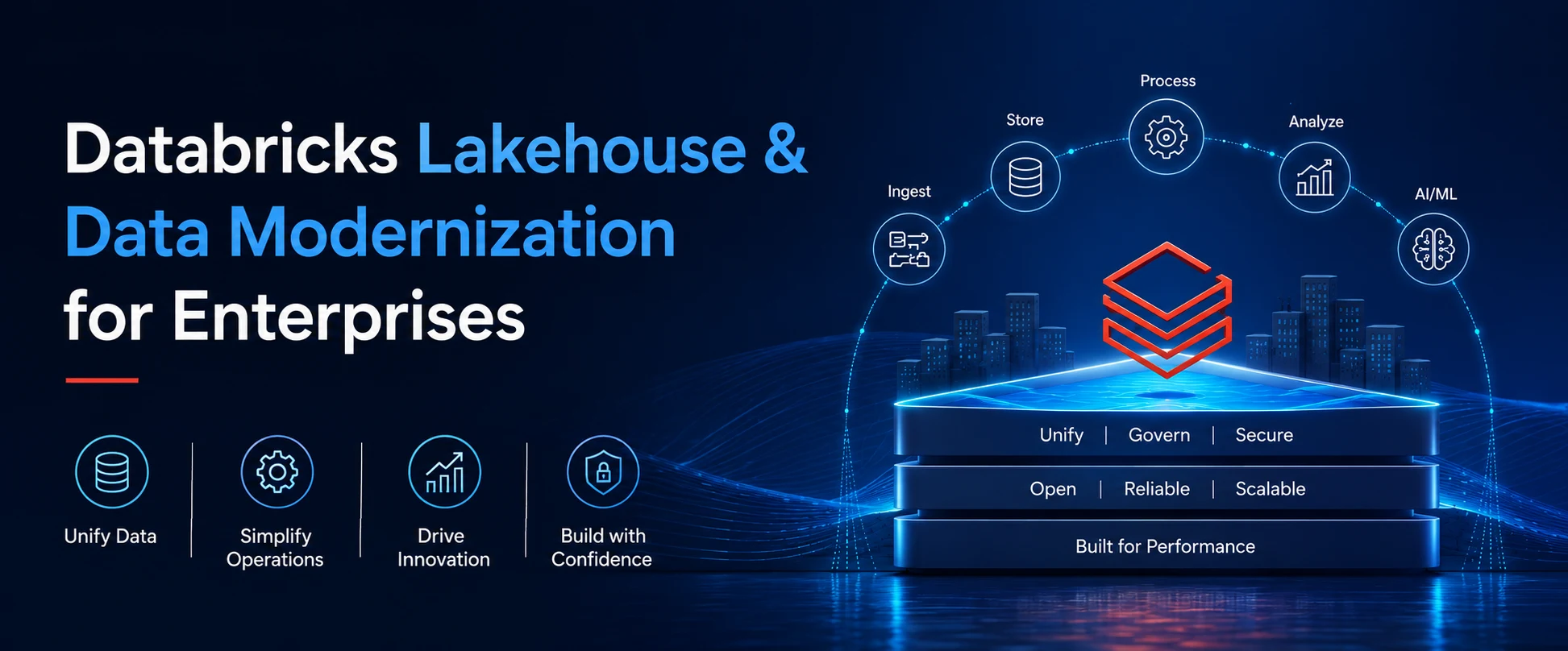
Key takeaways
- Databricks has become the foundational platform for GCCs managing massive data volumes, complex multi-cloud environments, and aggressive AI roadmaps.
- Unified data platforms on Databricks Lakehouse deliver 40% reduction in infrastructure costs and 60% reduction in data reconciliation time.
- Real-time analytics enables GCCs to detect operational anomalies quickly with 80%+ reduction in end-to-end latencies.
- MLflow and Mosaic AI accelerate AI/ML implementation from months to weeks with governed, production-grade deployments.
- Unity Catalog transforms regulatory compliance from manual effort into automated platform capability.
Global Capability Centers (GCCs) have undergone a fundamental transformation, evolving into strategic innovation hubs that drive digital transformation by adopting AI and data-driven decision-making for their parent organizations. This evolution has created a critical requirement for data and AI platforms powerful enough to keep pace with the global growth of GCCs.
In 2026, Databricks has become the leading platform, with over 10,000 enterprise customers globally, including Fortune 500 companies. For GCCs managing massive data volumes, complex multi-cloud environments, and aggressive AI roadmaps, Databricks will be the basic foundation for empowering them to stay competitive in the AI world.
Here are the five impactful use cases GCCs are deploying on Databricks and the outcomes they are delivering.
Use Case 1Unified Data Platform Replacing Fragmented Legacy Stacks
The GCC Challenge
Most GCCs inherited a fragmented data landscape from their parent organizations with multiple data warehouses, disconnected data lakes, overlapping BI tools, and siloed databases spread across business units and geographies. Data engineers spend most of their time reconciling inconsistencies between systems rather than building intelligence. A single business question such as "What is our global revenue by product line this quarter?" can require pulling data from multiple systems, none of which agree with the other.
The Databricks Solution
Databricks Lakehouse consolidates the entire data stack onto a single, unified platform. Delta Lake provides a reliable and ACID-compliant storage foundation. Unity Catalog delivers centralized governance such that GCCs can manage data discovery, access control, lineage, and compliance across teams and every cloud. Thus, GCCs get a single source of truth that every team across geographies can access, trust, and query simultaneously.
The GCC Outcome
GCCs that have unified their data stack on Databricks report a 40% reduction in data infrastructure costs, a 60% reduction in time spent on data reconciliation, and the elimination of shadow spreadsheets and conflicting reports. More importantly, they build a foundation that every subsequent AI and analytics initiative can stand on without rebuilding from scratch.
According to Business Wire, Databricks Lakehouse customers found that the solution delivered an average ROI of 482 percent over three years, with an average annual benefit of $30.5M and a payback period of 4.1 months.
Use Case 2Real-Time Analytics for Global Operations
The GCC Challenge
GCCs support parent organization operations across multiple time zones, markets, and business functions simultaneously. Supply chain disruptions, customer service escalations, fraud occurrences, and operational anomalies might occur at any time. Yet, most GCCs still rely on batch-processed analytics that deliver old data; there still exists a lag that translates directly into missed opportunities and undetected risks.
The Databricks Solution
Databricks structured streaming enables GCCs to ingest, process, and analyze data in real time from IoT sensors, application streams, transaction logs, social media feeds, and API pipelines, all enabled at enterprise scale. Delta Live Tables automates the construction and monitoring of real-time data pipelines, ensuring data quality at every stage of the stream without human intervention.
The GCC Outcome
GCCs running real-time analytics on Databricks detect operational anomalies quickly and achieve an 80%+ reduction in end-to-end latencies. They deliver real-time dashboards that give parent organization leadership effective real-time visibility into global performance. This replaces static weekly reports with dynamic, real-time intelligence that drives informed decision-making.
Use Case 3AI and Machine Learning Implementation at Enterprise Scale
The GCC Challenge
AI and ML have moved from competitive differentiator to table stakes for GCCs in 2026. Parent organizations expect their GCCs to deliver predictive models, demand forecasting systems, and GenAI applications that transform business processes. Yet most GCC teams struggle with the same recurring obstacles of fragmented, ungoverned, low-quality data that make building reliable, production-grade AI models difficult and slow.
The Databricks Solution
Databricks provides a unified environment for the AI and ML lifecycle, from data preparation and feature engineering to model training, tracking, deployment, and monitoring. MLflow, natively integrated into Databricks, gives a single platform to track experiments, compare, manage, and deploy models to production with full lineage and reproducibility. Databricks AutoML accelerates the path from data to deployed model, automatically generating baseline models that teams can build on rather than starting from scratch. For GenAI, Databricks Mosaic AI provides the infrastructure to fine-tune, evaluate, and deploy large language models on enterprise data with the governance and security that regulated industries demand.
The GCC Outcome
GCCs adopting Databricks reduce model development cycles from months to weeks and move AI initiatives from POC to production deployment at scale. They build a governed AI platform that parent organizations trust enough to embed in customer-facing and business-critical workflows. This delivers the AI-driven value that elevates the GCC's strategic position globally.
Use Case 4Data-Driven Talent Intelligence and Workforce Analytics
The GCC Challenge
GCCs are fundamentally talent organizations that deliver value to parent companies through people, capability, and professionals across engineering, data science, finance, operations, and technology functions. Yet, workforce decisions such as hiring, upskilling, attrition prediction, and performance management are still made on intuition in most GCCs. HR data sits in one system, performance data in another, skills data in a third, and they lack a unified view of the workforce they are managing.
The Databricks Solution
Databricks enables GCCs to build unified workforce intelligence platforms by consolidating HR, performance, learning, recruitment, and operational data into a single governed Lakehouse. Predictive models built on this unified data forecast attrition risk at the individual level before it becomes a resignation, identify skill gaps before they become delivery risks, and optimize talent allocation across projects and geographies in real time.
When combined with platforms like Talentalign, Adroitent's Native AI and Agentic Recruitment Platform, and the Databricks data foundation, it enables end-to-end talent intelligence, from augmenting talent and predicting what skills the GCCs need to automated screening, ranking candidates and getting the right fit in minutes.
The GCC Outcome
GCCs adopting Talentalign and Databricks-powered workforce analytics report a significant reduction in voluntary attrition through early intervention and also an effective improvement in time-to-hire through data-driven recruitment optimization. It also significantly improves delivery predictability, as capacity planning with a data-driven workforce strategy is effectively aligned with the parent organization's business roadmap.
Use Case 5Regulatory Compliance and Data Governance across Geographies
The GCC Challenge
GCCs operating in India, the United States, Europe, the Middle East, and Southeast Asia face an increasingly complex regulatory landscape. GDPR in Europe, DPDP in India, CCPA in California, and sector-specific regulations in financial services, healthcare, and defense sectors sometimes create conflicting data governance requirements that legacy systems were never designed to manage. Data residency, access control, lineage tracking, consent management, and audit readiness are not optional, and yet most GCCs manage compliance manually.
The Databricks Solution
Databricks' Unity Catalog (unified governance solution) helps transform compliance from a manual, reactive effort into an automated platform capability. Data lineage is tracked automatically from ingestion to consumption while attribute-based access control enforces data residency and privacy requirements at the platform level. Audit logs are generated automatically, making internal audits and external certifications faster and less resource-intensive.
The GCC Outcome
GCCs running governance on Unity Catalog reduce compliance audit preparation time significantly, eliminate manual lineage documentation, and confidently expand into new markets and data partnerships. This governance follows the data automatically, regardless of which team, which tool, or which cloud environment touches it. Compliance stops being a cost center and becomes a competitive capability that enables GCCs to win business in regulated industries.
ConclusionDatabricks is the GCC Data Platform for 2026 and Beyond
As GCCs continue to evolve into strategic innovation engines, Databricks is becoming a critical platform for enabling enterprise-wide data and AI transformation. From Lakehouse modernization and Generative AI to real-time analytics, customer intelligence, and predictive operations, Databricks empowers GCCs to deliver measurable business outcomes at scale.
The five use cases outlined above share a common thread: they are only possible on a platform that unifies data, governance, analytics, and AI without compromise. Siloed data lakes cannot power production AI that parent organizations trust. Organizations that invest in these high-impact use cases will position their GCCs as centers of excellence capable of driving innovation, improving efficiency, and creating sustainable competitive advantage.
In 2026, the most successful GCCs will be those that leverage Databricks not just as a data platform, but as a catalyst for business transformation and AI-driven growth.
Explore Adroitent's Data & AI solutions and learn how we help GCCs build unified data platforms on Databricks.
Transform your GCC with Databricks.
Talk to our experts about building a unified data and AI platform for your Global Capability Center.
Keep reading